Masterclass: Pistol sight adjustment
When to click, when not to click — and everything that moves your group without touching the pistol.
Group first. Click second. Confirm third.
The two adjustments
Moves the group vertically. Group low → move the group up.
Moves the group horizontally. Group right → move the group left.
On most precision pistols you move the rear sight in the direction you want the group to go — but the millimetres per click differ between pistols and sights. Learn your own markings before you use them under match pressure.
Your sights are not just correcting the pistol
One of the biggest misconceptions in precision pistol is that once a pistol is zeroed, the sights should stay where they are. They often don't. The pistol may not have changed at all, and the group still moves — because you changed, the light changed, the environment changed, or the way you perceive the sights changed.
Experienced shooters don't only ask "where is my group?" They ask "why is my group there?" Think of zero as mechanical zero + shooter + environment + visual system + current physical state. The goal is not to never touch the sights. It is to know when to touch them.
 Walked through by Calder · Technique
Adjust groups, not individual shots
Never chase shots around the target. Five shots clearly centred slightly left can justify an adjustment. Five shots spread left, right, high, low and centre tell you something different: the group is too large to make a reliable sight decision. The worse the grouping, the less confidently you can diagnose the zero.
First establish a group. Then adjust the group.
 Walked through by Milo · Performance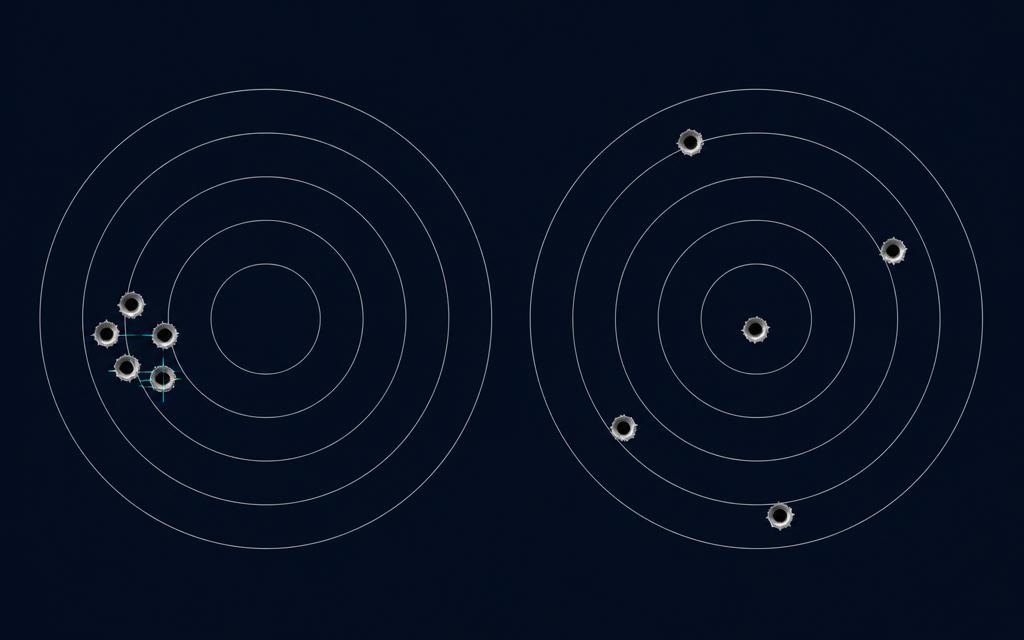
Sight error or shooting error?
Likely a sight adjustment: the shots are reasonably tight, repeatedly displaced in the same direction, felt technically good, and were called roughly where you expected. Likely a technique problem: scattered shots, occasional big flyers, the group moving between series, poor trigger releases, a changing grip or inconsistent sight alignment. Fix the execution first.
Walked through by Calder · TechniqueYour shot call is the evidence
After every shot, decide where you think it went before you look. "Good shot, centre" and a hole at nine o'clock means very little once. Five times in a row, it is evidence for a sight change. And when you say "I pulled that one left" and it is left — the pistol did exactly what it was told. Never correct the sights for an error you called correctly.
 Walked through by Rhea · Mental
Light moves your apparent zero
Light is the most underestimated variable in precision pistol. Bright sun, overcast, low evening light, sun from one side, covered or open firing points, target and sight illumination, indoor LED, shadows, target-to-background contrast — all of it changes how you read rear sight → front sight → aiming area → black bull. The geometry hasn't changed; your perception of it has. ISSF pistol coaching material explicitly warns that range lighting, and even the changing angle of the sun on a 25 m range, can alter grouping.
Filters and iris are tools for exactly this: darker filters in intense light, brighter or yellow-type filters in weak light. The objective is never a beautiful target — it is sight alignment that is easy to perceive.
Keep in mind: light at the range can require an adjustment even when nothing on the pistol has changed.
Walked through by Calder · Technique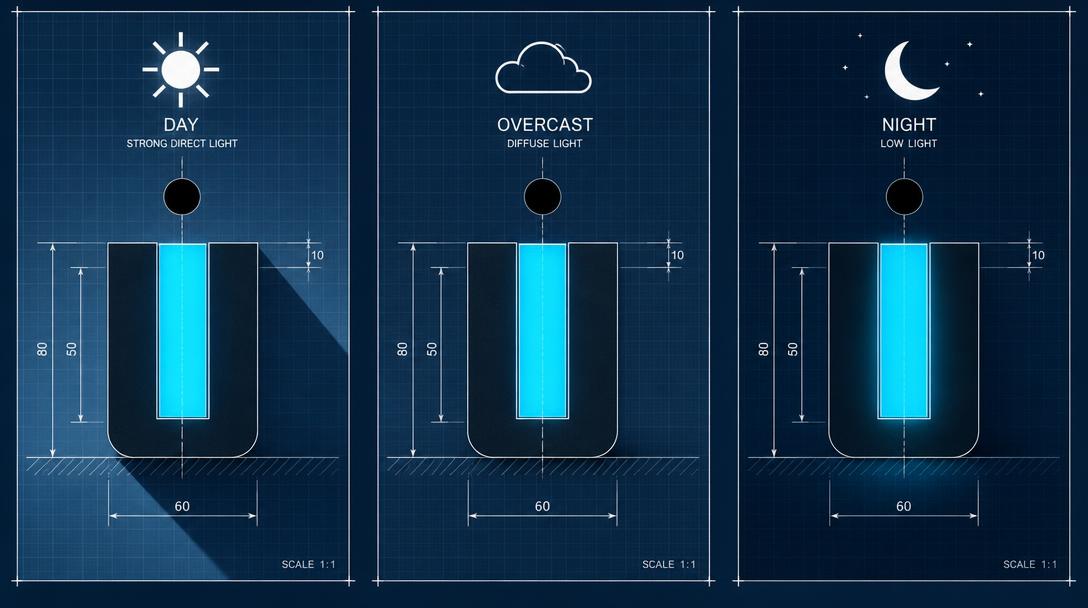
Front sight, notch width and tired eyes
Sharp sights, acceptably blurred target — not a sharp target and hopefully aligned sights. Rear notch width is not a comfort setting: a narrow notch makes small alignment errors obvious but starves the front sight of light, a wider notch gives clearer light bars and easier acquisition but can feel less precise. The aim is the picture you can recognise as aligned, repeatedly, without visual strain.
Your visual system is not a camera. After long concentration contrast perception drops, focusing slows, the light gaps look different and the temptation to look at the target grows. Series one centred, series four high-left, is not automatically a sight problem. ISSF coaching uses roughly three to four seconds of final front-sight focus as a benchmark — aiming longer is not aiming better. When the picture deteriorates: lower the pistol, reset, start again.
Walked through by Calder · TechniqueEverything else that mimics a zero change
Fatigue changes muscles, grip, shoulder stability, sway and fine motor control; physiological tremor increases with prolonged loading. Cold reduces finger sensitivity and changes how the trigger feels; heat brings sweat, dehydration and cognitive load. Wind at 25 m acts more on your arm, torso and clothing than on the bullet — gusts enlarge the group rather than displacing it consistently. Rain matters mostly through light, contrast and grip. Grip pressure, thumb pressure, wrist tension and trigger-finger placement can each move a group exactly like a sight error would.
Stance decides where the pistol naturally wants to settle. If you keep forcing it sideways onto the target, it drifts back during the trigger release. Before clicking eight left: check your feet. And under pressure, stress changes grip, breathing, timing and attention — beautiful groups in training and a displaced group in competition is usually a technique story, not a sight story.
Walked through by Rhea · MentalAmmunition, cleaning and balance
Different ammunition can print in a different place — velocity, recoil impulse and barrel dynamics all matter. If you train with one load and compete with another, measure the difference instead of assuming it away. After cleaning, disassembly, sight or grip removal, or a change of weights, verify the zero. A sudden unexplained displacement is a reason to check for a loose rear sight, loose front sight, loose grip or loose screws before clicking wildly. Changing the pistol's mass or its distribution changes hold, fatigue and recoil behaviour — reconfirm the zero whenever you move weight.
 Walked through by Ivy · Competition
Never aim off to fix a zero
The group is low, so the shooter starts holding a little higher. Then a little more. Soon there are two aiming pictures: the normal one, and the strange one used because the sights are wrong. Don't. If the group is genuinely displaced, adjust the sights and keep your normal sight picture.
Walked through by Calder · TechniqueThe three-group confirmation method
Unsure whether to click? Shoot three groups without changing anything, and compare their centres. Left, left, left is strong evidence — click right. Left, centre, right means the sight is not your main problem. Small corrections beat emotional corrections: observe → confirm → correct → verify, never shoot → panic → click → click again.
Walked through by Milo · PerformanceThe two mistakes
Never clicking: a beautiful group sitting in the nine ring while you spend forty shots trying to "shoot better". Those are thrown-away points. Clicking constantly: every bad shot produces another adjustment until neither you nor the pistol has a known zero. The skill sits between them — trust patterns, not individual shots. A sight adjustment is not a reaction to a bad shot; it is a statistical correction to a repeatable pattern.
Every shot is produced by a system: shooter + eyes + brain + grip + trigger + pistol + ammunition + sights + light + weather + environment. The sights compensate for the repeatable output of that whole system. That is why an experienced shooter isn't afraid to adjust — and isn't afraid not to.
Walked through by Ivy · CompetitionThe competition decision tree
Your group is left. Work down the list.
- 1Is there actually a group?No: Don't click yet — establish a group first.
- 2Did I call the shots left?No: If you called them left, it is execution. Don't click.
- 3Did the shots feel technically good?No: Fix the execution first.
- 4Has the displacement repeated across several shots?No: Wait. One series is not evidence.
- 5Did something obvious change — light, wind, stance, grip, eyes, fatigue, glasses, ammunition, the pistol?No: Nothing changed and the group still moved — continue.
- 6Would I still make this correction if I couldn't see the score?No: Then it is emotion, not evidence.
All the way down? Click — then shoot normally. Do not compensate for your own correction.
Pre-click checklist
If all of these are stable and the group is still displaced: adjust the sights.
Keep a sight log
- Pistol, ammunition, range, date
- Elevation setting / windage setting
- Light: bright sun · overcast · indoor · low light · mixed shadow
- Temperature and wind
- Eyes: fresh · normal · tired · very tired
- Body: fresh · normal · fatigued
- Group tendency and the adjustment you made
Record the setting together with light, temperature, wind and how fresh your eyes were. After enough sessions patterns appear — "in strong sunlight I usually need two clicks down", or "after 40 shots my group goes left, and clicking never fixes it". The second one is the valuable one: it tells you the sights were never the problem.
Let the team watch your zero
ShootMind.com computes the centre of your group from your logged targets, tells you how many clicks that is — and whether your grouping is even consistent enough to justify a change.