Masterclass: Rifle sight adjustment
When to click, when not to click — and why a rifle zero is a system, not a setting.
Group → Measure → Adjust → Confirm.
The two adjustments
Moves the group vertically. Group low → move the group up.
Moves the group horizontally. Group right → move the group left.
Rifle sights and scopes usually have a defined click value, often expressed in MOA, MRAD/mil or a specific movement at a given distance. One click at 100 m is not the same on the target as one click at 25 m. Learn your markings before you use them under pressure.
Your sights are not just correcting the rifle
A properly zeroed rifle puts the centre of your group where you intend it to be. But a change in point of impact doesn't automatically mean the sights need adjusting. The rifle, ammunition, shooter and environment form one complete system. A zero is a snapshot of that system at a particular moment — not a permanent property of the rifle.
Experienced shooters don't only ask 'where is my group?' They ask 'why is my group there?' Think of zero as mechanical zero + shooter + position + environment + visual system + current physical state. The goal is not to never touch the sights. It is to know when to touch them.
 Walked through by Calder · Technique
Adjust groups, not individual shots
Never adjust your sights because of one bad shot. Shoot a group, evaluate its centre and ask: was the group displaced, or did I simply make shooting errors? A reasonably tight group consistently high, low, left or right can justify an adjustment. A scattered group usually means you should solve the grouping problem first.
First establish a group. Then adjust the group.
 Walked through by Milo · Performance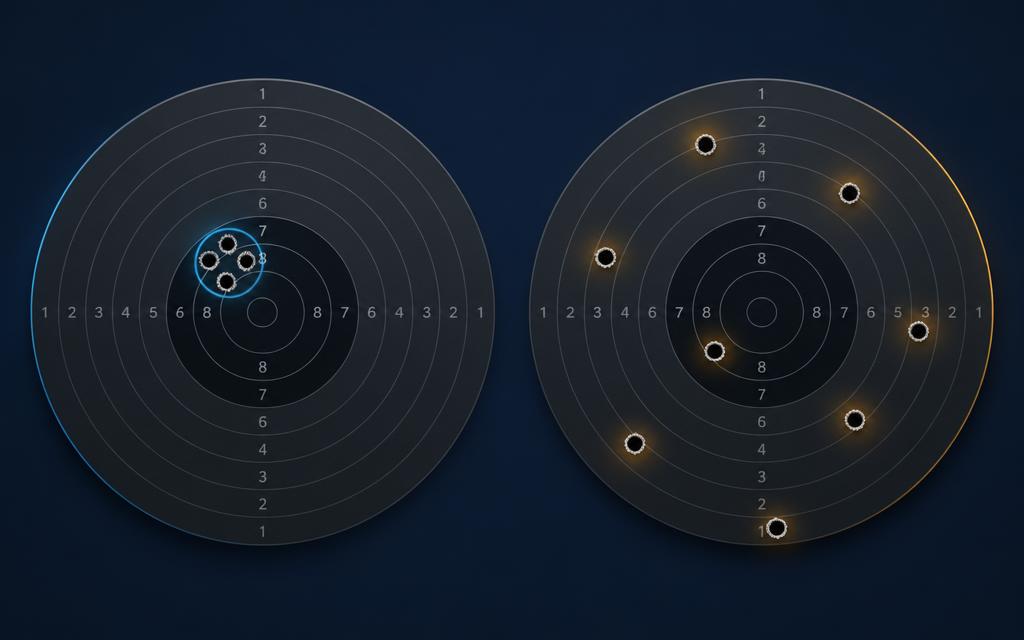
Know your clicks
Rifle sights and scopes usually have a defined adjustment value, commonly expressed in MOA, MRAD/mil or a specific movement per click. For example, if one click moves the point of impact 10 mm at 100 m, the same angular adjustment produces approximately 5 mm at 50 m, 10 mm at 100 m and 20 mm at 200 m. Know the click value of your particular sight and understand how it changes with distance.
Walked through by Milo · PerformanceDistance changes everything
A rifle zero is associated with a particular distance. A rifle zeroed at 50 m will not necessarily hit the same point relative to your aiming point at 100, 200 or 300 m. This is because the bullet follows a trajectory while your sight provides an essentially straight line of sight. Therefore always record: rifle + ammunition + sight setting + distance.
Walked through by Calder · TechniquePosition changes point of impact
Your zero may change between prone, standing, kneeling, benchrest, supported and unsupported shooting. The rifle may be identical, but your interaction with it isn't. Changes in shoulder pressure, cheek position, grip and support can alter the group centre. Zero the rifle in the position relevant to the shooting you're actually doing.
Walked through by Calder · TechniqueHead and cheek position
Consistent head position is particularly important with rifle shooting. Changing your cheek weld can change your relationship to the sights. With iron sights, inconsistent alignment can create aiming errors. With a scope, poor eye position can introduce problems including parallax-related aiming error when the target and reticle are not optically aligned at the shooting distance. Build the same head position for every shot.
Walked through by Calder · TechniqueLight and iron sights
Light can significantly change how iron sights appear. Bright sunlight, overcast conditions, shadows and illumination from different directions can change your perception of the front sight, rear aperture or notch, target, aiming mark and the sight-to-target relationship. A rifle that appears to require a sight correction may actually be exposing a change in how you're seeing the sights. Before making a large correction, consider whether the lighting changed.
Keep in mind: light at the range can require an adjustment even when nothing on the rifle has changed.
Walked through by Calder · Technique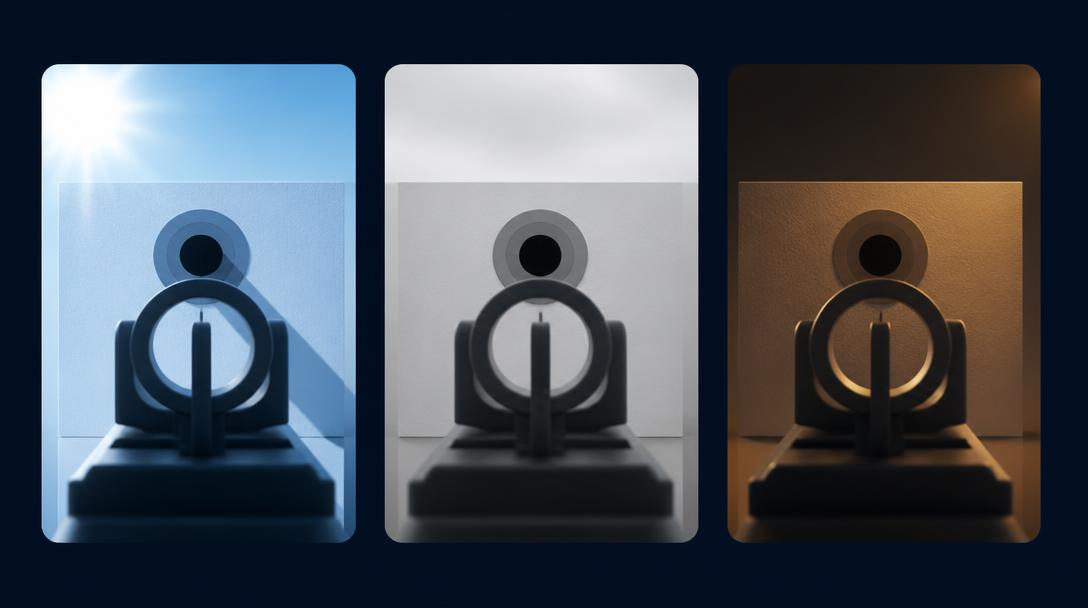
Eyes and visual fatigue
Your eyes are part of the sighting system. As they become tired, you may experience reduced contrast, difficulty maintaining focus, inconsistent sight alignment, changing perception of the aiming mark and slower visual processing. This is particularly relevant during long training sessions and competitions. If your group begins moving late in a session, don't automatically assume the rifle zero has changed.
 Walked through by Rhea · Mental
Natural point of aim
Natural point of aim is especially important in rifle shooting. Once you're in position, the rifle should naturally point toward the target without significant muscular effort forcing it there. If your natural point of aim is left of the target and you're continually using muscle tension to pull the rifle right, the rifle will tend to return toward its natural position. Move your body or position rather than fighting the rifle.
Walked through by Calder · TechniqueWind
As distance increases, wind becomes increasingly important. Wind can affect both the bullet in flight and the shooter and rifle position. A temporary crosswind doesn't necessarily mean you should permanently change your zero. Experienced shooters distinguish between zero correction and condition correction. That distinction becomes increasingly important as distance increases.
 Walked through by Ivy · Competition
Temperature and weather
Temperature can affect ammunition performance, muzzle velocity, rifle components, shooter comfort, muscle control, clothing, grip and shoulder pressure. Air density also changes with atmospheric conditions and can influence trajectory, particularly at longer distances. At shorter ranges these ballistic differences may be small. At longer ranges they become increasingly relevant. Record conditions when establishing important zeros.
Walked through by Ivy · CompetitionAmmunition
Changing ammunition can change point of impact. Even ammunition with the same bullet weight can behave differently because of differences in velocity, bullet design, powder, barrel harmonics and consistency. Never assume that two ammunition types share the same zero. When changing ammunition, verify it.
Walked through by Milo · PerformanceBarrel temperature
As a rifle barrel heats during a shooting session, point of impact can sometimes change. How much depends on the rifle, barrel, ammunition and shooting sequence. If you repeatedly see the first shots from a cold barrel grouping somewhere different from later shots, record it. A repeatable cold-bore difference is useful information.
Walked through by Milo · PerformanceEquipment changes
Reconfirm your zero after significant changes such as changing sights or scope, removing and reinstalling an optic, changing ammunition, changing stock setup, changing cheekpiece position, changing buttplate position, adding or removing weights, or changing support equipment. If the group suddenly moves dramatically without explanation, inspect the equipment before making major sight corrections. Check mounts, screws, sights and other components.
Walked through by Ivy · CompetitionPhysical fatigue
As the shooter tires, position may deteriorate, shoulder pressure may change, stability can decrease, trigger control can deteriorate and head position may change. Visual concentration can also decrease. A group that moves late in a match might therefore indicate fatigue rather than a changed zero. Look at your good shots. If properly executed shots consistently land somewhere other than expected, a sight adjustment becomes more reasonable.
Walked through by Rhea · MentalThe rifle sight-adjustment decision
Before clicking, ask: Do I have a real group? Did I call the shots somewhere else? Was my position consistent? Was my natural point of aim correct? Was my head and cheek position consistent? Has the wind changed? Has the light changed? Am I becoming tired? Did the ammunition or equipment change? If your execution is good and the group remains consistently displaced, adjust the sights.
The principle is simple: don't use your sights to correct bad shooting. Don't use your shooting technique to compensate for badly adjusted sights. When the group is good but in the wrong place, move the group.
Walked through by Calder · TechniqueHow to adjust your rifle sights
Adjust your sights to move the centre of the group, not individual shots. If your group is consistently left, move the group right; right, move the group left; low, move the group up; high, move the group down. Check the markings and instructions for your particular iron sight or optic before adjusting it. Know your click value and distance. A click represents an angular correction, so its movement on the target increases with distance. A correction that moves the group 5 mm at 50 m will move it approximately 10 mm at 100 m.
Make a calculated correction, shoot another group and verify the result. Before adjusting, also consider wind, position, natural point of aim, head position, ammunition, light and fatigue. These can move a rifle group without the mechanical zero actually changing. A simple rule: Group → Measure → Adjust → Confirm. If the group is tight but in the wrong place, adjust the sights. If the group is scattered, work on the shooting first.
Walked through by Calder · TechniqueThe competition decision tree
Your group is left. Work down the list.
- 1Is there actually a group?No: Don't click yet — establish a group first.
- 2Did I call the shots somewhere else?No: If your call matches the impact, it is execution. Don't click.
- 3Was my position consistent?No: Fix the position first.
- 4Was my natural point of aim correct?No: Move your body, not the sights.
- 5Has the displacement repeated across several shots?No: Wait. One series is not evidence.
- 6Did something obvious change — light, wind, position, ammunition, temperature, eyes, fatigue, or the rifle?No: Nothing changed and the group still moved — continue.
- 7Would I still make this correction if I couldn't see the score?No: Then it is emotion, not evidence.
All the way down? Click — then shoot normally. Do not compensate for your own correction.
Pre-click checklist
If all of these are stable and the group is still displaced: adjust the sights.
Keep a zero log
- Rifle, ammunition, distance, position, date
- Sight / optic model
- Elevation setting / windage setting
- Click value (MOA, MRAD or mm per click at a given distance)
- Light: bright sun · overcast · indoor · low light · mixed shadow
- Temperature and wind
- Eyes: fresh · normal · tired · very tired
- Body: fresh · normal · fatigued
- Group centre and the adjustment you made
Record the setting together with light, temperature, wind and how fresh your eyes were. After enough sessions patterns appear — 'in strong sunlight my group drops', or 'after a long match my group goes left and clicking never fixes it'. The second one is the valuable one: it tells you the sights were never the problem.
Let the team watch your zero
ShootMind.com computes the centre of your group from your logged targets, tells you how many clicks that is — and whether your grouping is even consistent enough to justify a change.